La Luniwen Syntax
The simple sentence
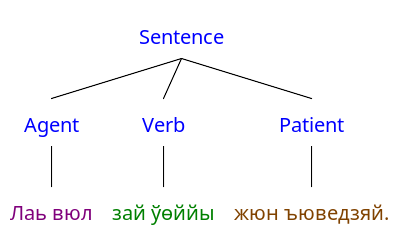 |
| The wolf is located in the sheepfold. |
Like Mandarin or English, La Luniwen has a Subject-Verb-Object (SVO) structure. There is no inflections. No gender/number/case marking, no verb conjugation. To indicate the tense, one must use a time adverb, that will be put between the aspect preverb and the verb root.
The verb must be preceded by an aspect preverb. Here зай (zay) indicates the progressive aspect. As there is no time adverb, the sentence is considered present continuous.
There are 6 lexical aspects (Aktionsarten) preverbs in La Luniwen :
| Лаь Лыніўен | IPA | Translation | Aspect | Explanation |
|---|---|---|---|---|
| лаљ (lalh) | [laɮ] | once | semelfactive | The process happens once, shortly |
| жӹ (zhå) | [ʐə] | again | iterative | The process is repeated |
| зай (zay) | [zaj] | in | durative | The process is happening, in length |
| лыў (lü̈w) | [lɯw] | in case of | hypothetical | The process is theorical |
| мил (mǐl) | [mil] | world | gnomic | The verb doesn't describe a single process but a general truth |
| гон (gon) | [gɔn] | end | perfective | The process is over |
Note that the verb ўөййы (wʌ̌yyü) is to be located. There is actually no copula in La Luniwen. For example, the sentence "The wolf is a sheep" would be :
Лаъ вюл ъювед (Lah vǒl hǒvěd).
Literally, "The wolf sheep". As in Russian, this structure can be used for attribute adjectives.
Compare : лаь желзө вюл (lah zhělzʌ̌ vǒl) = the black wolf ;
With : лаь вюл желзө (lah vǒl zhělzʌ̌) = the wolf is black.
Topicalization and indirect second complement
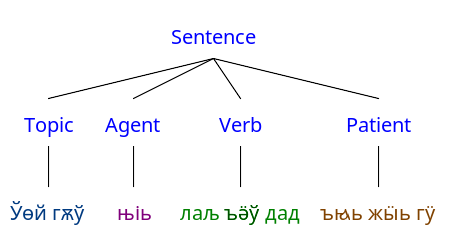 |
| To the dog you will give a bone. |
In La Luniwen, the only way to add an indirect second complement is by using the topicalization, thus both grammatical features are treated as one. If the topic is the subject, the topicalization is not necessary. Else, you'll have to put the topic before the subject, starting with the preposition ўөй (wʌ̌y).
If the topic is the object, the sentence will logically ends by the verb. Here, as the sentence has both a topic and an object at the usual position, the topic is an indirect second complement. In this example, the topic is the dog who will receive the bone from you.
(NB : The future is indicated by adding the time adverb ъӛў (hʌ̊w) "after" between the aspect preverb and the verb)
Close-ended questions (a.k.a yes-no questions)
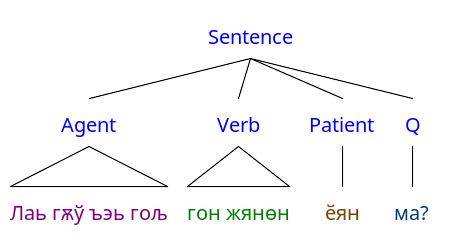 |
| Do the dog and [the] cat did ate well ? |
As in Mandarin, the close-ended questions are just affirmations with ма (ma) added at the end.
As in Russian, you can answer with да (da) or њэд (nhed). If the question includes more than one topic, you can use split-topicalization to answer them individually.
Ўөй гѫў да, ўөй гољ њэд.
Wʌ̌y gǫw da, wʌ̌y golh nhed.
The dog yes, the cat no.
Open-ended questions (a.k.a WH- questions)
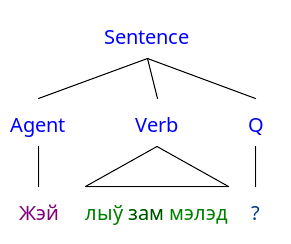 |
| Who could die from it ? |
The position of the interrogative adverb is theorically free, and often placed right after the questioned part of the sentence. But its default place is right after the subject. However, йи (yǐ) "what" and жэй (zhey) "who" will replace the subject if it's the asked thing.
Here, the "adverb" ɛам (zam) is actually the reflexive marker which indicate the subject of the sentence is actually the patient, not the agent as the rest of the syntax seems to indicate. This structure is kinda between a reflexive and a passive.
Notes on the genitive
 |
| I am taking care of my mother's canary. |
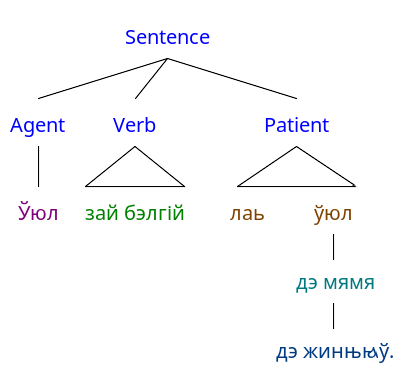
Like in Mandarin, the genitive in La Luniwen is built by putting the owned after the owner (like in English), linked with the conjunction дэ (de). If the owner is itself owned, it chains all down to the last non-owner.
Лаь ўюл дэ мямя дэ жинњꙗў
The patient of the sentence is the bolded part. As you can see, the definite article comes before the owner's owner even though it refers to the owned. As with the previous example лаь гѫў ъэь гољ (lah gǫw heh golh gon) "the dog and cat", the definite article can refer to a whole composite group. If you don't want it to apply to something, just put it before the article : гољ ъэь лаь гѫў (golh heh lah gǫw) "a cat and the dog".
La Luniwen Numbers
The grammatical numbers :
La Luniwen doesn't distinguish grammatical numbers, at least structurally. You can use any number or quantifier before the noun classifier, but after the definite article if there is one.
The noun classifiers are 20 particles which corresponds to the 20 noun classes of La Luniwen. They must be put between any number/quantifier and (the adjectives before) the noun.
| Лыніўен | Lü̈niwěn | IPA | Category | Literal meaning |
|---|---|---|---|---|
| жоў | zhow | ʐɔw | animals | beast |
| ъыл | hul | hɯl | circles, spheres | round |
| лиљ | lǐlh | liɮ | arts, performance | art |
| дӛл | dʌ̊l | dʊl | artworks | painting |
| дів | div | dɪv | categories | type |
| зюн | zǒn | zon | cycles | again |
| бољ | bolh | bɔɮ | gigantic things | big |
| мэв | mev | mɛv | furniture | furniture |
| йӱв | yů̊v | jyv | grammar | grammar |
| ўꙗн | wąn | wɑ̃n | honorific titles | king |
| жян | zhǎn | ʐɑn | item parts | key |
| гій | giy | gɪj | machines | electrical |
| дѧь | dęh | dẽx | money | money |
| луд | lǔd | lut | people | people |
| зәл | zʌl | zʌl | pieces of a whole | grain |
| лөь | lʌ̌h | lɤx | places | in |
| зав | zav | zav | plants | plant |
| бꙗл | bąl | bɑ̃l | stick-shaped | stick |
| йѫў | yǫw | jõw | wholes | have |
| жӹь | zhåh | ʐəx | bodyparts | limb |
The cardinal numbers :
Like Russian and Mandarin, La Luniwen has a decimal counting system.
Numbers below 99 are agglutinated. 100, 1'000 and 10'000 must be written with a digit before a specific quantifier adverb. One million, one billion and upper require a "gigantic" classifier (бољ) to be written.
| 0 | нољ (nolh) | 10 | жі (zhi) | 20 | давжі (davzhi) | 30 | дилжі |
| 1 | ъꙗь (hąh) | 11 | жіьйꙗь (zhihyąh) | 21 | давжіьйꙗь (davzhihyąh) | 40 | зіджі |
| 2 | дав (dav) | 12 | жіьдав (zhihdav) | 22 | давжіьдав (davzhihdav) | 50 | бӹджі |
| 3 | дил (dǐl) | 13 | жіьдил | 23 | давжіьдил | 60 | жэзжі |
| 4 | зід (zid) | 14 | жіьзід | 24 | давжіьзід | 70 | зѧмжі |
| 5 | бӹд (båd) | 15 | жіьбӹд | 25 | давжіьбӹд | 80 | возимжі |
| 6 | жэз (zhez) | 16 | жіьжэз | 26 | давжіьжэз | 90 | дољйыжі |
| 7 | зѧм (zęm) | 17 | жіьзѧм | 27 | давжіьзѧм | 100 | ъꙗь йегадюн |
| 8 | возим (vozǐm) | 18 | жіьвозим | 28 | давжіьвозим | 1000 | ъꙗь ъилйой |
| 9 | дољйы (dolhyü̈) | 19 | жіьдољйы | 29 | давжіьдољйы | 10000 | ъꙗь мӱлйад |
Examples :
дољйыжіьдољйы [dɔɮ.jɯ.ʐɪx'tɔɮ.jɯ] = dolhyüzhihdolhyü = 99.
бӹд йегадюн бӹджіьбӹд [bət je'ga.don bəd'ʐɪx.pət] = båd yěgadǒn bådzhihbåd = 555.
бӹд ъилйой жэз йегадюн зѧмжіьвозим [bət 'hil.jɔj ʐɛz je'ga.don zẽm.ʐɪx'fɔ.zim] =
båd hǐlyoy zhez yěgadǒn zęmzhihvozǐm = 5678.
ъꙗь мӱлйад дав йегадюн дилжіьзід [hɑ̃x 'myl.jat dav je'ga.don dil'ʐɪx.sɪt] =
hąh můlyad dav yěgadǒn dǐlzhihzid = 10234.
The ordinal numbers
The ordinal numbers are built by adding the prefix дӹ (då) to the cardinal number, except for one-syllable numbers, that is to say 0 to 7 digits, and 10. Before those, you'll add the strenghtened version ды (dü).
Examples :
дыбӹд ['dɯ.bət] = dübåd = fifth.
дӹзѧмжіьдил [də.zɛ̃m'ʐɪx.til] = dåzęmzhihdǐl = seventy-third.
The multiple numbers
The multiples are built by adding the suffix зӹ (zå) to the cardinal number.
Examples :
дилзӹ ['dil.zə] = dǐlzå = three times.
зіджіьзѧмзӹ [zɪd.ʐɪx'sɛ̃m.zə] = zidzhihzęmzå = fourty-seven times.
The fraction numbers
The fractions are built like in mandarin, as full divisions. The denominator comes first, separated from the numerator by the conjunction вен (věn).
Examples :
зід вен ъꙗь [zɪt ven hɑ̃x] = zid věn hąh = one quarter.
йегадюн вен жэзжіьдав [jegadon ven ʐɛz'ʐɪx.tav] = yěgadǒn věn zhezzhihdav = sixty-two hundredth.
(NB : In the case of that fraction, you don't need to put ъꙗь before йегадюн as there isn't one of it anyways)
La Luniwen Phonology [læ lʌ'ni.wɪn fəˈnɒ.lə.dʒi]
Vowels :
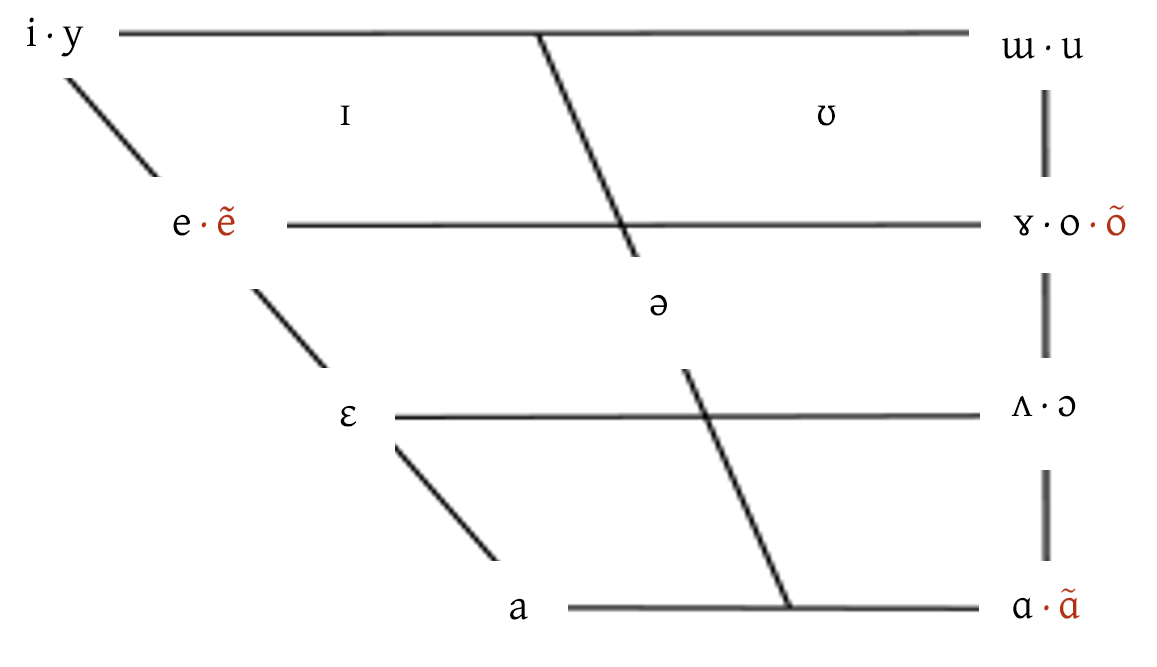
La Luniwen has 15 vocal phonemes (plus 3 nasal phonemes).
Consonants :
La Luniwen has 16 consonants, including 3 semivowels (plus 7 allophones).
| Bilabial | Labio- dental |
Labio- palatal |
Alveolar | Palato- Alveolar |
Palatal | Velar | Labio- velar |
Glottal | |
|---|---|---|---|---|---|---|---|---|---|
| Nasal | m | n | ɲ | ||||||
| Stop | p b | t d | k g | ||||||
| Fricative | f v | s z | ʂ ʐ | x | h | ||||
| Approximant | ɥ | j | w | ||||||
| Lateral fricative | ɬ ɮ | ||||||||
| Lateral approximant | l |
Phonotactics, allophony and reparations
The syllable structure of La Luniwen is a simple CV(C). The colors refer to the Luniwen Orthography table.
Αs for the vowels, La Luniwen is always phonemic. The only documented case of vocalic reparation is the ordinal prefix дӹ- [də] that strenghens into ды- [dɯ] when stressed.
As for the consonants, there are only seven regular rules which triggers allophony or reparations.
- д /d/ is always devoiced into [t] in final position.
- Each consonant having a devoiced allophone will be devoiced when directly following ь /x/.
- ў /w/ is weakened into [ɥ] when following a "pre-posterior" vowel : ӹ /ə/, ӛ /ʊ/, ө /ɤ/ or ә /ʌ/.
- ъ /h/ is always mute when following м /m/, в /v/ or д /d/.
- ъ /h/ becomes й /j/ when following ь /x/.
- You must add ь /x/ after a final і /ɪ/ when adding a suffix to it.
- Clitics like the definite article, the noun classifiers and the verb aspects aren't considered as distinct from the word they're linked to. Thus the rule n°1 doesn't apply if the linked word is right behind and starts with any letter but ъ /h/ or a semivowel, and the rule n°2 allophony is triggered if the clitic ends with ь /x/ (for example, the definite article лаь [lax]).
Stress
The word stress is always on the second-to-last syllable. No exception. And yes, that means the rule n°7 applies before a monosyllabic noun/verb.
La Luniwen Orthographies :
Лыніўен, Lü̈niwěn and
La Luniwen can be written in three ways :
- The only official orthography is using the cyrillic alphabet. Only voiced consonant glyphs are used even in devoiced contexts. The vowel glyphs used for pre-palatalized vowels in Russian are used for closed vowels while the regular ones are used for opened vowels. The three nasal vowels are represented with the iotacized a ꙗ [ɑ̃], little yus ѧ [ɛ̃], and big yus ѫ [õ]. Else, it's pretty straightforward.
- The romanization, that is to say the transcription using latin alphabet, is also known as scientific notation. The reason of that nomenclature is that most countries outside the Sino-Russian Union (SRU) are using the latin alphabet for scientific publications, so that international translation computers can parse more easily. It relies a lot on diacritics and +h consonants. The only non-standard characters outside diacritics are ‹ɥ› and ‹ʌ›.
- At the creation of the SRU, a popular contest had been run to determine the writing system that would have been on use. The idea was using something new, neutral, so that no member of the Union was advantaged. The winner of the contest, a Tibetan script-inspired featural alphabet with a syllabic structure that reads top to bottom (like Korean hangul), was quite arbitrarily labeled as too difficult and used as a way to force the cyrillic alphabet on the table ("You voted for a phonemic alphabet ? We have a phonemic alphabet !" – The Russian delegation).
Nowadays, the featural alphabet is still in use, but mainly within the artistic community.
(NB : Most resources on this website only shows the official, cyrillic alphabet exclusively)
Below is a full correspondance table. It reads, from top to bottom : artistic alphabet, scientific alphabet, official alphabet, and IPA phonemic pronunciation. Emerald green is onset, hazelnut yellow is nucleus, navy blue is coda.
| | | | | | | | | | | | | | | | |||
| y | w | ɥ | m | n | nh | b | d | g | l | lh | zh | v | z | h | |||
| й | ў | ӗ | м | н | њ | б | д | г | л | љ | ж | в | з | ъ | |||
| j | w | ɥ | m | n | ɲ | b | d | g | l | ɮ | ʐ | v | z | h | |||
| | | | | | | | | | | | | | | | | | |
| a | e | i | o | ü̈ | ʌ | ą | ę | ǫ | å | ů̊ | ʌ̊ | ǎ | ě | ǐ | ǒ | ǔ̌ | ʌ̌ |
| а | э | і | о | ы | ә | ꙗ | ѧ | ѫ | ӹ | ӱ | ӛ | я | е | и | ю | у | ө |
| a | ɛ | ɪ | ɔ | ɯ | ʌ | ɑ̃ | ẽ | õ | ə | y | ʊ | ɑ | e | i | o | u | ɤ |
| | | | | | | | | | | ||||||||
| y | w | lh | d | l | v | h | m | n | ∅ | ||||||||
| й | ў | љ | д | л | в | ь | м | н | ∅ | ||||||||
| j | w | ɮ | d | l | v | x | m | n | ∅ | ||||||||