The Ámérizkunxa Conjugation
Ámérizkunxa features a mechanism called polypersonal agreement. More precisely, a transitive verb is marked both for the agent and the direct object, while an intransitive verb is only marked for the subject.
Ámérizkunxa has 18 pronouns : 10 for the terrestrial gender, and 8 for the divine gender. The 2nd person (both singular and plural) of the terrestrial gender is distinguished by politeness (T-V distinction). And for both genders, the 3rd person pronouns are distinguished by obviation, that is to say by the relative distance to the speaker, whether physical or conceptual. By convention, I'll refer to the the 3rd person obviative pronouns as « 4th person » pronouns.
Strong Form Tenses
Ámérizkunxa has two inflectional tenses, called "strong" because the agreements directly affect the verb. These tenses are non-future, and future. Out of context, non-future primarily tends to mark present, not past. It is usually formed by adding the subject agreement to the verb stem. The future is formed similarly, but the verb is suffixed by its first vowel followed by the unvoiced consonant corresponding to its first consonant. For example, the future stem for oboter « may » is oboterop-.
As stated above, the conjugation of an intransitive verb isn't polypersonal. For that, the possible forms are significantly reduced. Here are all possible strong forms for the verb zkun « to speak » :
| ni (1T) | sánní (1D) | hi (2TI) | zu (2TF) | ƶú (2D) | rų (3T) | réy (3D) | bę (4T) | báyí (4D) |
|---|---|---|---|---|---|---|---|---|
| zkuni | zkuná | zkunę | zkune | zkuné | zkunu | zkunú | zkunubu | zkunúbú |
| zkunuzo | zkunuzó | zkunuzj | zkunuzųl | zkunuzų́l | zkunuzeu | zkunuzéú | zkunuzeua | zkunuzéúá |
| ger (1TP) | ságéy (1DP) | hyek (2TIP) | zoyek (2TFP) | ƶólík (2DP) | ręu (3TP) | ríyú (3DP) | byek (4TP) | bálík (4DP) |
| zkunixę | zkuníxá | zkunękę | zkuneke | zkunéká | zkunųrre | zkunų́rrá | zkunubę | zkunúbá |
| zkunuzoy | zkunuzóy | zkunuzir | zkunuzuy | zkunuzúy | zkunuzay | zkunuzá | zkunuzaya | zkunuzáyá |
On the other hand, transitive verb conjugation is a bit more complicated : with 18 pronouns and 2 tenses, it's theorically 648 possible forms for a single verb. However, some agent-patient pairs are impossible. For example, a first person terrestrial plural cannot be associated with a first person divine singular, as the divine gender prevails. These forms are greyed out. Here is an example with the verb mųzit « make wet » :
| Non-Future | 1T | 1D | 2TI | 2TF | 2D | 3T | 3D | 4T | 4D | 1TP | 1DP | 2TIP | 2TFP | 2DP | 3TP | 3DP | 4TP | 4DP |
|---|---|---|---|---|---|---|---|---|---|---|---|---|---|---|---|---|---|---|
| 1T | mųziti | mųzitid | mųzitija | mųzitijá | mųzitir | mųzitirá | mųzitip | mųzitibá | mųzitig | mųzitiská | mųzitij | mųzitiz | mųzitiƶá | mųzitirr | mųzitirrá | mųzityek | mųzitilká | |
| 1D | mųzitá | mųzitád | mųzitája | mųzitájá | mųzitár | mųzitárá | mųzitáp | mųzitábá | mųzitáská | mųzitáj | mųzitáz | mųzitáƶá | mųzitárr | mųzitárrá | mųzitáek | mųzitálka | ||
| 2TI | mųzitęy | mųzitęyá | mųzitę | mųzitęr | mųzitęrá | mųzitęp | mųzitębá | mųzitęg | mųzitęská | mųzitęj | mųzitęz | mųzitęƶá | mųzitęrr | mųzitęrrá | mųzitęyek | mųzitęlká | ||
| 2TF | mųzitey | mųziteyá | mųzite | mųziter | mųziterá | mųzitep | mųzitebá | mųziteg | mųziteská | mųzitez | mųziteƶá | mųziterr | mųziterrá | mųziteyek | mųzitelká | |||
| 2D | mųzitéy | mųzitéyá | mųzité | mųzitér | mųzité | mųzitép | mųzitébá | mųzitég | mųzitéská | mųzitéƶá | mųzitérr | mųzitérrá | mųziték | mųzitélká | ||||
| 3T | mųzituy | mųzituyá | mųzitud | mųzituja | mųzitujá | mųzitu | mųzitup | mųzitubá | mųzitug | mųzituská | mųzituj | mųzituz | mųzituƶá | mųziturr | mųziturrá | mųzityek | mųzitulká | |
| 3D | mųzitúy | mųzitúyá | mųzitúd | mųzitúja | mųzitújá | mųzitú | mųzitúp | mųzitúbá | mųzitúg | mųzitúská | mųzitúj | mųzitúz | mųzitúƶá | mųzitúrr | mųzitúrrá | mųzityék | mųzitúlká | |
| 4T | mųzitubuy | mųzitubuyá | mųzitubud | mųzitubuja | mųzitubujá | mųzitubur | mųzituburá | mųzitubu | mųzitubug | mųzitubuská | mųzitubuj | mųzitubuz | mųzitubuƶá | mųzituburr | mųzituburrá | mųzitubyek | mųzitubulká | |
| 4D | mųzitúbúy | mųzitúbúyá | mųzitúbúd | mųzitúbúja | mųzitúbújá | mųzitúbúr | mųzitúbúrá | mųzitúbú | mųzitúbúg | mųzitúbúská | mųzitúbúj | mųzitúbúz | mųzitúbúƶá | mųzitúbúrr | mųzitúbúrrá | mųzitúbyék | mųzitúbúlká | |
| 1TP | mųzitixęy | mųzitixęd | mųzitixęja | mųzitixęjá | mųzitixęr | mųzitixęrá | mųzitixęp | mųzitixębá | mųzitixę | mųzitixęj | mųzitixęz | mųzitixęƶá | mųzitixęrr | mųzitixęrrá | mųzitixęyk | mųzitixęlká | ||
| 1DP | mųzitíxáy | mųzitíxáyá | mųzitíxád | mųzitíxája | mųzitíxájá | mųzitíxár | mųzitíxárá | mųzitíxáp | mųzitíxábá | mųzitíxá | mųzitíxáj | mųzitíxáz | mųzitíxáƶá | mųzitíxárr | mųzitíxárrá | mųzitíxáyk | mųzitíxálká | |
| 2TIP | mųzitękęy | mųzitękęyá | mųzitękęd | mųzitękęr | mųzitękęrá | mųzitękęp | mųzitękębá | mųzitękęg | mųzitękęská | mųzitękę | mųzitękęrr | mųzitękęrrá | mųzitękęyk | mųzitękęlká | ||||
| 2TFP | mųzitekey | mųzitekeyá | mųziteked | mųzitekeja | mųziteker | mųzitekerá | mųzitekep | mųzitekebá | mųzitekeg | mųzitekeská | mųziteke | mųzitekerr | mųzitekerrá | mųzitekek | mųzitekelká | |||
| 2DP | mųzitékáy | mųzitékáyá | mųzitékád | mųzitékája | mųzitékájá | mųzitékár | mųzitékárá | mųzitékáp | mųzitékábá | mųzitékág | mųzitékáská | mųzitéká | mųzitékárr | mųzitékárrá | mųzitékáyk | mųzitékálká | ||
| 3TP | mųzitųrrey | mųzitųrreyá | mųzitųrred | mųzitųrreja | mųzitųrrejá | mųzitųrrer | mųzitųrrerá | mųzitųrrep | mųzitųrrebá | mųzitųrreg | mųzitųrreská | mųzitųrrej | mųzitųrrez | mųzitųrreƶá | mųzitųrre | mųzitųrrek | mųzitųrrelká | |
| 3DP | mųzitų́rráy | mųzitų́rráyá | mųzitų́rrád | mųzitų́rrája | mųzitų́rrájá | mųzitų́rrár | mųzitų́rrárá | mųzitų́rráp | mųzitų́rrábá | mųzitų́rrág | mųzitų́rráská | mųzitų́rráj | mųzitų́rráz | mųzitų́rráƶá | mųzitų́rrá | mųzitų́rráyk | mųzitų́rrálká | |
| 4TP | mųzitubęy | mųzitubęyá | mųzitubęd | mųzitubęja | mųzitubęjá | mųzitubęr | mųzitubęrá | mųzitubęp | mųzitubębá | mųzitubęg | mųzitubęská | mųzitubęj | mųzitubęz | mųzitubęƶá | mųzitubęrr | mųzitubęrrá | mųzitubę | |
| 4DP | mųzitúbáy | mųzitúbáyá | mųzitúbád | mųzitúbája | mųzitúbájá | mųzitúbár | mųzitúbárá | mųzitúbáp | mųzitúbábá | mųzitúbág | mųzitúbáská | mųzitúbáj | mųzitúbáz | mųzitúbáƶá | mųzitúbárr | mųzitúbárrá | mųzitúbá |
| Future | 1T | 1D | 2TI | 2TF | 2D | 3T | 3D | 4T | 4D | 1TP | 1DP | 2TIP | 2TFP | 2DP | 3TP | 3DP | 4TP | 4DP |
|---|---|---|---|---|---|---|---|---|---|---|---|---|---|---|---|---|---|---|
| 1T | mųzitųmo | mųzitųmod | mųzitųmoja | mųzitųmojá | mųzitųmor | mųzitųmorá | mųzitųmop | mųzitųmobá | mųzitųmog | mųzitųmoská | mųzitųmoj | mųzitųmoz | mųzitųmoƶá | mųzitųmorr | mųzitųmorrá | mųzitųmoyk | mųzitųmolká | |
| 1D | mųzitųmó | mųzitųmód | mųzitųmója | mųzitųmójá | mųzitųmór | mųzitųmórá | mųzitųmóp | mųzitųmóbá | mųzitųmóská | mųzitųmój | mųzitųmóz | mųzitųmóƶá | mųzitųmórr | mųzitųmórrá | mųzitųmóyk | mųzitųmólká | ||
| 2TI | mųzitųmji | mųzitųmhųyá | mųzitųmj | mųzitųmhųr | mųzitųmhųrá | mųzitųmhųp | mųzitųmhųbá | mųzitųmhųg | mųzitųmhųská | mųzitųmhųj | mųzitųmhųz | mųzitųmhųƶá | mųzitųmhųrr | mųzitųmhųrrá | mųzitųmjek | mųzitųmhųlká | ||
| 2TF | mųzitųmųli | mųzitųmųlųyá | mųzitųmųl | mųzitųmųlųr | mųzitųmųlrá | mųzitųmųlp | mųzitųmųlbá | mųzitųmųlg | mųzitųmųlųská | mųzitųmųlz | mųzitųmųlƶá | mųzitųmųlųrr | mųzitųmųlrrá | mųzitųmųlek | mųzitųmųlųlká | |||
| 2D | mųzitųmų́li | mųzitųmų́lų́yá | mųzitųmų́l | mųzitųmų́lų́r | mųzitųmų́lrá | mųzitųmų́lp | mųzitųmų́lbá | mųzitųmų́lg | mųzitųmų́lų́ská | mųzitųmų́lƶá | mųzitųmų́lų́rr | mųzitųmų́lrrá | mųzitųmų́lek | mųzitųmų́lų́lká | ||||
| 3T | mųzitųmeuy | mųzitųmeuyá | mųzitųmeud | mųzitųmeuja | mųzitųmeujá | mųzitųmeu | mųzitųmeup | mųzitųmeubá | mųzitųmeug | mųzitųmeuská | mųzitųmeuj | mųzitųmeuz | mųzitųmeuƶá | mųzitųmeurr | mųzitųmeurrá | mųzitųmeuek | mųzitųmeulká | |
| 3D | mųzitųméúy | mųzitųméúyá | mųzitųméúd | mųzitųméúja | mųzitųméújá | mųzitųméú | mųzitųméúp | mųzitųméúbá | mųzitųméúg | mųzitųméúská | mųzitųméúj | mųzitųméúz | mųzitųméúƶá | mųzitųméúrr | mųzitųméúrrá | mųzitųméúek | mųzitųméúlká | |
| 4T | mųzitųmeuay | mųzitųmeuayá | mųzitųmeuad | mųzitųmeuaja | mųzitųmeuajá | mųzitųmeuar | mųzitųmeuará | mųzitųmeua | mųzitųmeuag | mųzitųmeuaská | mųzitųmeuaj | mųzitųmeuaz | mųzitųmeuaƶá | mųzitųmeuarr | mųzitųmeuarrá | mųzitųmeuayk | mųzitųmeualká | |
| 4D | mųzitųméúáy | mųzitųméúáyá | mųzitųméúád | mųzitųméúája | mųzitųméúájá | mųzitųméúár | mųzitųméúárá | mųzitųméúábá | mųzitųméúág | mųzitųméúáská | mųzitųméúáj | mųzitųméúáz | mųzitųméúáƶá | mųzitųméúárr | mųzitųméúárrá | mųzitųméúáyk | mųzitųméúálká | |
| 1TP | mųzitųmoyi | mųzitųmoyd | mųzitųmoyja | mųzitųmoyjá | mųzitųmoyr | mųzitųmoyrá | mųzitųmoyp | mųzitųmoybá | mųzitųmoy | mųzitųmoyj | mųzitųmoyz | mųzitųmoyƶá | mųzitųmoyrr | mųzitųmoyrrá | mųzitųmoyek | mųzitųmoylká | ||
| 1DP | mųzitųmóyi | mųzitųmóyų́yá | mųzitųmóyd | mųzitųmóyja | mųzitųmóyjá | mųzitųmóyr | mųzitųmóyrá | mųzitųmóyp | mųzitųmóybá | mųzitųmóy | mųzitųmóyj | mųzitųmóyz | mųzitųmóyƶá | mųzitųmóyrr | mųzitųmóyrrá | mųzitųmóyek | mųzitųmóylká | |
| 2TIP | mųzitųmiri | mųzitųmiryá | mųzitųmird | mųzitųmirr | mųzitųmirrá | mųzitųmihp | mųzitųmirbá | mųzitųmirg | mųzitųmirská | mųzitųmir | mųzitųmirųrr | mųzitųmirųrrá | mųzitųmirek | mųzitųmirųlká | ||||
| 2TFP | mųzitųmuyi | mųzitųmuyųyá | mųzitųmuyd | mųzitųmuyja | mųzitųmuyr | mųzitųmuyrá | mųzitųmuyp | mųzitųmuybá | mųzitųmuyg | mųzitųmuyská | mųzitųmuy | mųzitųmuyrr | mųzitųmuyrrá | mųzitųmuyek | mųzitųmuylká | |||
| 2DP | mųzitųmúyi | mųzitųmúyų́yá | mųzitųmúyd | mųzitųmúyja | mųzitųmúyjá | mųzitųmúyr | mųzitųmúyrá | mųzitųmúy | mųzitųmúybá | mųzitųmúyg | mųzitųmúyská | mųzitųmúy | mųzitųmúyrr | mųzitųmúyrrá | mųzitųmúyek | mųzitųmúylká | ||
| 3TP | mųzitųmayi | mųzitųmayųyá | mųzitųmayd | mųzitųmayja | mųzitųmayjá | mųzitųmayr | mųzitųmayrá | mųzitųmayp | mųzitųmaybá | mųzitųmayg | mųzitųmayská | mųzitųmayj | mųzitųmayz | mųzitųmayƶá | mųzitųmay | mųzitųmayek | mųzitųmaylká | |
| 3DP | mųzitųmáy | mųzitųmáyá | mųzitųmád | mųzitųmája | mųzitųmájá | mųzitųmár | mųzitųmárá | mųzitųmáp | mųzitųmábá | mųzitųmág | mųzitųmáská | mųzitųmáj | mųzitųmáz | mųzitųmáƶá | mųzitųmá | mųzitųmáyk | mųzitųmálká | |
| 4TP | mųzitųmayay | mųzitųmayayá | mųzitųmayad | mųzitųmayaja | mųzitųmayajá | mųzitųmayar | mųzitųmayará | mųzitųmayap | mųzitųmayabá | mųzitųmayag | mųzitųmayaská | mųzitųmayaj | mųzitųmayaz | mųzitųmayaƶá | mųzitųmayarr | mųzitųmayarrá | mųzitųmaya | |
| 4DP | mųzitųmáyáy | mųzitųmáyáyá | mųzitųmáyád | mųzitųmáyája | mųzitųmáyájá | mųzitųmáyár | mųzitųmáyárá | mųzitųmáyáp | mųzitųmáyábá | mųzitųmáyág | mųzitųmáyáská | mųzitųmáyáj | mųzitųmáyáz | mųzitųmáyáƶá | mųzitųmáyárr | mųzitųmáyárrá | mųzitųmáyá |
Relative Form Tenses
Ámérizkunxa has two relative forms that add onto strong forms to form a total of six "compound" tenses. Both are marked with a prefix added onto the conjugated form :
- The anterior form prefix zau-, associated with the non-future, marks the past tense. With the future, it marks the past-in-the-future (anterior future) tense.
- The posterior form prefix di-, associated with the non-future, marks the near future tense. With the future, it marks the remote future tense.
Weak Form ~&Aktionsarten
Onto the previous conjugations is added another dimension : the "weak form" is actually a participle form of the verb, associated with an auxiliary. The participle agrees with the listener's gender/rank, no matter what the sentence is about. The participle is marked by the prefix ǫr- and a suffix corresponding to the listener : -ǫ for the terrestrial inanimate (very rare but attested), -o for the terrestrial informal, -a for the terrestrial formal, and -á for the divine.
The auxiliary corresponds to one of those 18 Aktionsarten. An Aktionsart, or lexical aspect, is a verbal form (or here, an auxiliary) that lexically reflect an aspect, mood, or other specificity of the verb. They are :
| Auxiliary | Meaning | Aktionsart corresponding to it | In English |
|---|---|---|---|
| iʒam | be | Progressive : the action/state is happening overtime. | be +ing |
| ųzťs | hit | Instant : the action/state happened just once, really quickly. | + immediatly |
| paup | take | Inchoative : the action/state is starting. | start +ing |
| ekam | ᵃᵘˣ have | Effective : the action/state is ending. | end +ing |
| axau | know | Gnomic : it's always true. | One knows that + |
| ęsan₂ | say | Reported : the information was reported by someone to the speaker. | I was told that + |
| arraj | see | Visual evidence : the information was seen by the speaker. | I saw that + |
| uyar | hear | Auditive evidence : the information was heard by the speaker. | I heard that + |
| ƶbo̟l | embiggen | Intensive : the action/state is more intense than suggested. | + very much, a lot |
| ixipi | shrinken | Diminutive : the action/state is less intense than suggested. | + a bit, softly |
| eur₂ | come back | Iterative : the action is repeated again and again. | + again and again |
| egin | do | Factitive : action/state is achieved/reached by the agent due to the patient. | is forced to + by + |
| ǫno̟n | struggle | Difficult : the subject struggles to achieve/reach the action/state. | struggle to + |
| ajmen | go | Sative : The action/state is pushed as far as possible. | + to the max |
| ul | ask | Volitive : the subject wants to achieve/reach the action/state. | want to + |
| euax | try | Conative : the subject tries to achieve/reach the action/state. | try to + |
| oboter | be able | Conditional : The action/state is achieved/reached if some conditions are reached. | if… then + |
| e̟t₂ | order | Imperative : The action/state must be achieved/reached by the object. | one must + |
Auxiliaries are known to be irregular verbs. The most extreme example is the verb iʒam « to be » ; not only its stem is replaced with a highly mutated version of the agentive pronoun (the regular patientive agreement is preserved), but the reflexive/intransitive inflections mutated even further, losing their relatively regular stem.
For example, the first person terrestrial stem is niʒi-, merging of niz+iʒam {niʒi < ?niʒiʒmi < *niʒiʒimi < *niz͜ iʒami},
while the first person reflexive/intransitive (used with attribute adjectives) is nyaʒ {nyaʒ < ?niʒ͜͡a < *niziʒami < *niz͜ iʒami}.
(Notice that metathesis, that is the inversion of two nearby sounds, happened in monopersonal forms but not in polypersonal stems)
Below are featured non-future tenses only. The future tense being quite recent, it's unfortunately regular. The future stem for iʒam is thus iʒamis- for every person.
| Non-Future | 1T | 1D | 2TI | 2TF | 2D | 3T | 3D | 4T | 4D | 1TP | 1DP | 2TIP | 2TFP | 2DP | 3TP | 3DP | 4TP | 4DP |
|---|---|---|---|---|---|---|---|---|---|---|---|---|---|---|---|---|---|---|
| 1T | nyaʒ | niʒid | niʒija | niʒijá | niʒir | niʒirá | niʒip | niʒibá | niʒig | niʒiská | niʒij | niʒiz | niʒiƶá | niʒirr | niʒirrá | niʒyek | niʒilká | |
| 1D | náʒám | náʒimád | náʒimája | náʒimájá | náʒimár | náʒimárá | náʒimáp | náʒimábá | náʒimáská | náʒimáj | náʒimáz | náʒimáƶá | náʒimárr | náʒimárrá | náʒimáek | náʒimálka | ||
| 2TI | ʒęymęy | ʒęymęyá | ʒęym | ʒęymęr | ʒęymęrá | ʒęymęp | ʒęymębá | ʒęymęg | ʒęymęská | ʒęymęj | ʒęymęz | ʒęymęƶá | ʒęymęrr | ʒęymęrrá | ʒęymęyek | ʒęymęlká | ||
| 2TF | zumey | zumeyá | zeʒem | zumer | zumerá | zumep | zumebá | zumeg | zumeská | zumez | zumeƶá | zumerr | zumerrá | zumeyek | zumelká | |||
| 2D | ƶúʒiméy | ƶúʒiméyá | ƶéʒém | ƶúʒimér | ƶúʒimé | ƶúʒimép | ƶúʒimébá | ƶúʒimég | ƶúʒiméská | ƶúʒiméƶá | ƶúʒimérr | ƶúʒimérrá | ƶúʒimék | ƶúʒimélká | ||||
| 3T | dramuy | dramuyá | dramud | dramuja | dramujá | darum | dramup | dramubá | dramug | dramuská | dramuj | dramuz | dramuƶá | dramurr | dramurrá | dramyek | dramulká | |
| 3D | drámúy | drámúyá | drámúd | drámúja | drámújá | dárúm | drámúp | drámúbá | drámúg | drámúská | drámúj | drámúz | drámúƶá | drámúrr | drámúrrá | drámyék | drámúlká | |
| 4T | draymubuy | draymubuyá | draymubud | draymubuja | draymubujá | draymubur | draymuburá | daruym | draymubug | draymubuská | draymubuj | draymubuz | draymubuƶá | draymuburr | draymuburrá | draymubyek | draymubulká | |
| 4D | dráymúbúy | dráymúbúyá | dráymúbúd | dráymúbúja | dráymúbújá | dráymúbúr | dráymúbúrá | dárúym | dráymúbúg | dráymúbúská | dráymúbúj | dráymúbúz | dráymúbúƶá | dráymúbúrr | dráymúbúrrá | dráymúbyék | dráymúbúlká | |
| 1TP | giʒixęy | giʒixęd | giʒixęja | giʒixęjá | giʒixęr | giʒixęrá | giʒixęp | giʒixębá | giʒey | giʒixęj | giʒixęz | giʒixęƶá | giʒixęrr | giʒixęrrá | giʒixęyk | giʒixęlká | ||
| 1DP | gáʒéymíxáy | gáʒéymíxáyá | gáʒéymíxád | gáʒéymíxája | gáʒéymíxájá | gáʒéymíxár | gáʒéymíxárá | gáʒéymíxáp | gáʒéymíxábá | gáʒéy | gáʒéymíxáj | gáʒéymíxáz | gáʒéymíxáƶá | gáʒéymíxárr | gáʒéymíxárrá | gáʒéymíxáyk | gáʒéymíxálká | |
| 2TIP | ʒenękęy | ʒenękęyá | ʒenękęd | ʒenękęr | ʒenękęrá | ʒenękęp | ʒenękębá | ʒenękęg | ʒenękęská | ʒęnk | ʒenękęrr | ʒenękęrrá | ʒenękęyk | ʒenękęlká | ||||
| 2TFP | zyenekey | zyenekeyá | zyeneked | zyenekeja | zyeneker | zyenekerá | zyenekep | zyenekebá | zyenekeg | zyenekeská | zyene | zyenekerr | zyenekerrá | zyenekek | zyenekelká | |||
| 2DP | ƶúʒimékáy | ƶúʒimékáyá | ƶúʒimékád | ƶúʒimékája | ƶúʒimékájá | ƶúʒimékár | ƶúʒimékárá | ƶúʒimékáp | ƶúʒimékábá | ƶúʒimékág | ƶúʒimékáská | ƶúʒám | ƶúʒimékárr | ƶúʒimékárrá | ƶúʒimékáyk | ƶúʒimékálká | ||
| 3TP | drramųrrey | drramųrreyá | drramųrred | drramųrreja | drramųrrejá | drramųrrer | drramųrrerá | drramųrrep | drramųrrebá | drramųrreg | drramųrreská | drramųrrej | drramųrrez | drramųrreƶá | darrum | drramųrrek | drramųrrelká | |
| 3DP | drrámų́rráy | drrámų́rráyá | drrámų́rrád | drrámų́rrája | drrámų́rrájá | drrámų́rrár | drrámų́rrárá | drrámų́rráp | drrámų́rrábá | drrámų́rrág | drrámų́rráská | drrámų́rráj | drrámų́rráz | drrámų́rráƶá | dárrúm | drrámų́rráyk | drrámų́rrálká | |
| 4TP | drraymubęy | drraymubęyá | drraymubęd | drraymubęja | drraymubęjá | drraymubęr | drraymubęrá | drraymubęp | drraymubębá | drraymubęg | drraymubęská | drraymubęj | drraymubęz | drraymubęƶá | drraymubęrr | drraymubęrrá | darruym | |
| 4DP | drráymúbáy | drráymúbáyá | drráymúbád | drráymúbája | drráymúbájá | drráymúbár | drráymúbárá | drráymúbáp | drráymúbábá | drráymúbág | drráymúbáská | drráymúbáj | drráymúbáz | drráymúbáƶá | drráymúbárr | drráymúbárrá | dárrúym |
The Ámérizkunxa Syntax
The simple sentence
| Intransitive sentence (VᵢSₐ) : | Transitive sentence (SₑVₜOₐ) : |
|---|---|
 |
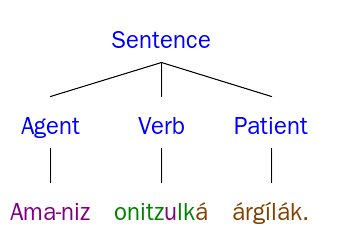 |
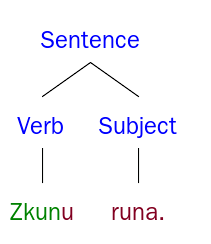
| The boy speaks. | My mum is looking [at] the stars. |
Like Basque, Ámérizkunxa has an impure ergative-absolutive morphosyntactic alignment. Impure, in that its sentence structure is accusative ; it results in the absolutive subject of an intransitive verb being put after said verb like an object.
The ergative case is marked [-(e)z] after its number, while the absolutive is unmarked. There is no other case in Ámérizkunxa, unless we count genitive as such. A genitive is formed by hyphenating the possessor after the possessee. Here, ama-niz is « my mum ».
In the strong form, transitive verbs agree with both the agent and the patient.
See more about the Ámérizkunxa Conjugation.
The completive subordinate
In Ámérizkunxa, only intransitive sentences can be completed with a completive subordinate clause.
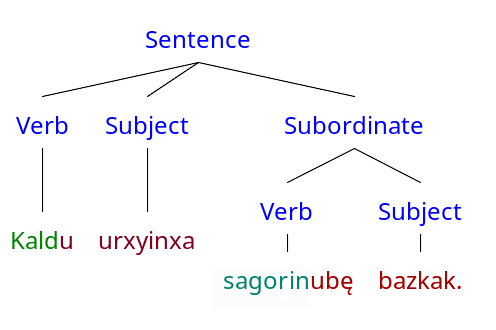 |
| The squirrel waits [for] the trees [to] fruit. |
The completive subordinate is simply put after the absolutive argument of the sentence. It stands as a direct object, but the subject isn't ergative. Here, with an intransitive verb (kald « to speak »), the absolutive argument is the subject. Contrary to English, the subordinate verb is conjugated too. When dealing with third person arguments, the subordinate is always obviative, even if it's animate. If the sentence were to be the other way round, both verbs would be conjugated to the "4ᵗʰ person" (sagorin because bazkak is inanimate, kald because it would be part of the subordinate).
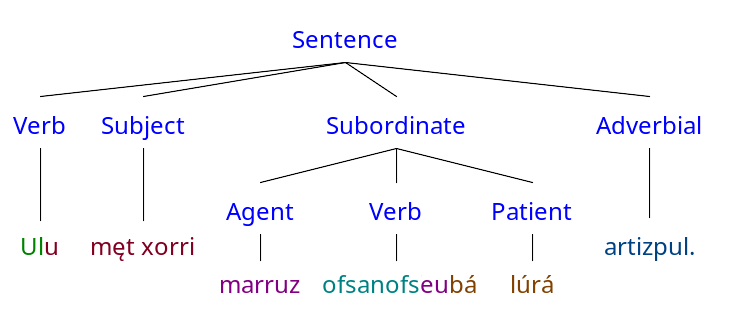 |
| The bird expects [that] a lizard will come out of the ground in the morning. |
As stated above, the relative subordinate is put after the absolutive argument, not at the end of the sentence. Here, the subordinate has a transitive verb, so the main clause absolutive subject xorri « bird » is followed by the subordinate ergative agent marru « lizard ». It doesn't affect the main clause structure.
However, this sentence has an adverbial clause (here, a temporal adverb). It is thus put after the subordinate, as the adverbial clause must be at the end of the whole sentence. It stacks this way.
The conjunctive (and relative) subordinate
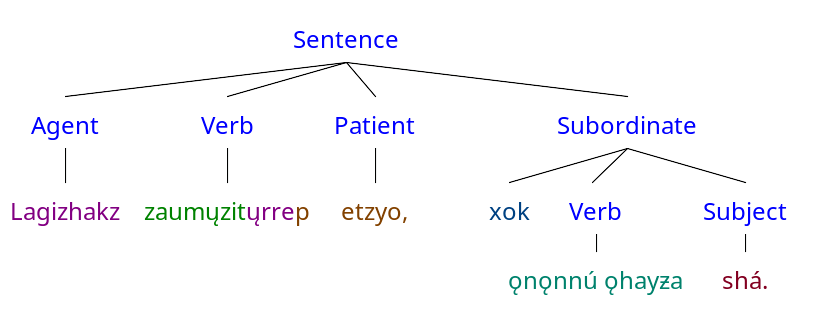 |
| The firefighters wetted the house, so that the fire struggles to spread. |
When a subordinate come with a conjunction, locution, or introduce a clause that is relative to the patient of a transitive sentence, the subordinate clause is put after a comma, and must start with a link word. Here, xok « for, because, so that » makes up a causal link between the main clause and the subordinate, that are otherwise independant clauses and could be part of split sentences (and xok « so that » could be replaced with o « and »).
Also notice that there is a temporal correspondence. While the verb of the main clause has an anterior grammatical aspect onto a present tense form (making it past), the relative clause has a present tense, making it thus happen after, as the consequence of the main clause.
Close-ended questions
In English, there are two ways to form an open-ended question : either with the auxiliary "do" at the beginning of an affirmative sentence, or with a question tag at the end. In Ámérizkunxa, only that second way is possible. There are three question tags :
- Atta means « yes », « right ? »
- Ses means « no », « wrong ? »
- Dirim means something like « Do you promise it will be the case soon ? ».
Atta and ses work the same was as in English, in that you assume something and the question tag is the least probable answer to you. The adressee will then agree or deny. Dirim is a special case : The adressor remind a fact to the adressee, and expect them to promise to change it.
Example : Ƶúz al zauęgisé al ǫrųzúrrená ger anno, dirim ?
« Thou didn't put rain above our head yet, will you please do so ? »
Open-ended questions
Open-ended questions begin with an interrogative adverb.
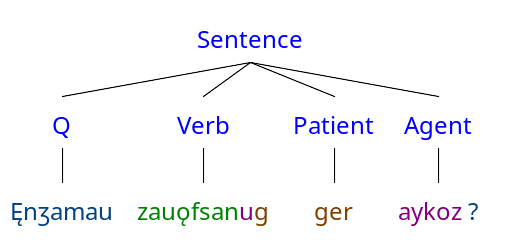 |
| For how long did the dog get away from us ? |
In transitive sentences, the ergative agent is put after the patient.
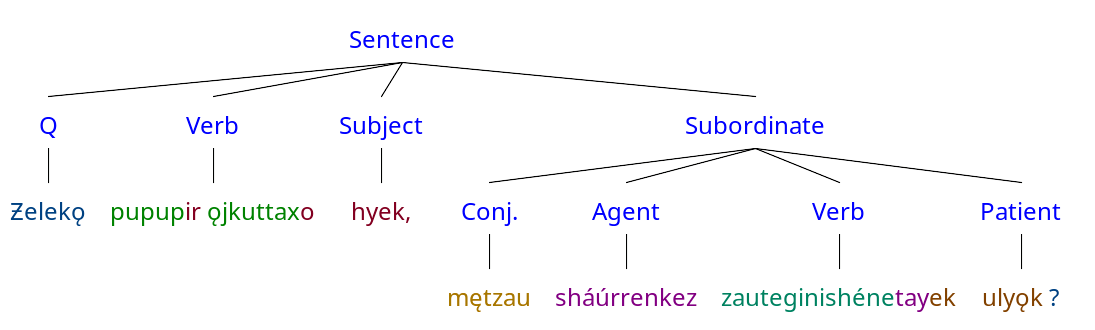 |
| Where will y’all begin to search, once the dragons will have burnt down the villages ? |
In intransitive sentences, the structure doesn't change. Similarly, if the question has a subordinate clause, its structure won't be affected either. In this second example, remove ƶelekǫ « where », and you have a grammatically correct affirmative sentence, which is not the case with the first example.
The Ámérizkunxa Phonology
[ðiː ə'mɛ.ɹɪs.kʊn.t͡ʃə fəˈnɒ.lə.dʒi]
Vowels :
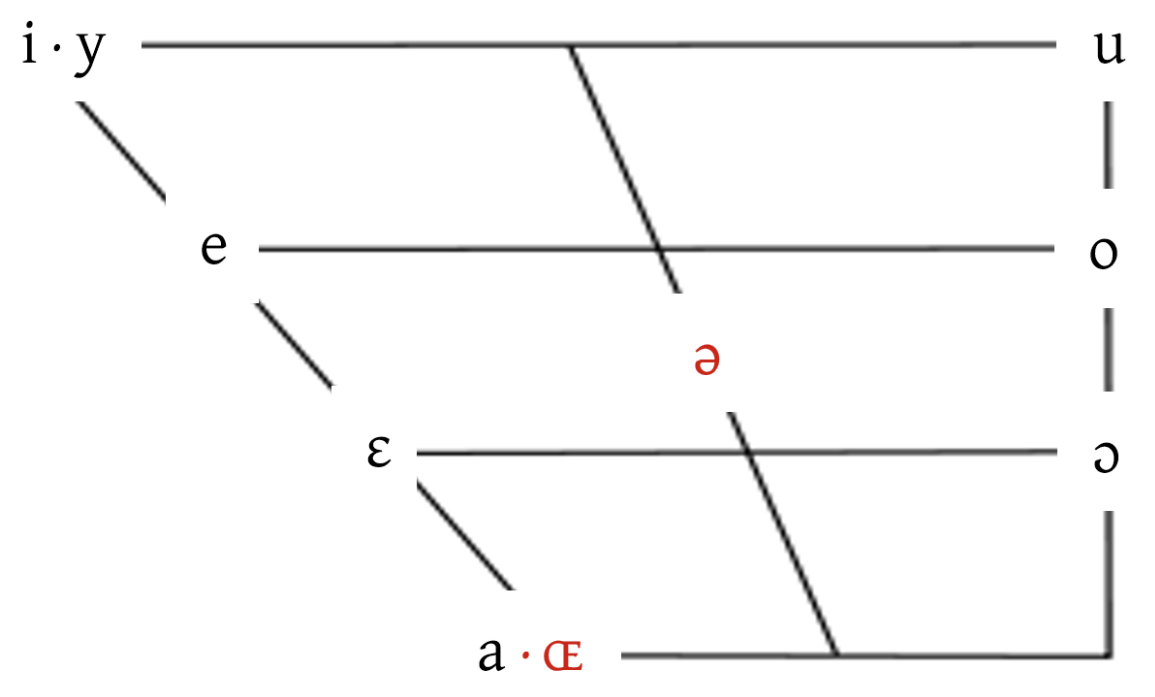
Ámérizkunxa has 8 vocal phonemes (plus 2 allophones).
Consonants :
Ámérizkunxa has 25 consonants (plus 3 allophones).
| Bilabial | Labio- Dental |
Dental | Alveolar | Palato- Alveolar |
Retroflex | Palatal | Velar | Labio- Velar |
Uvular (and Glottal) |
|
| Nasal | m | n | ɲ | |||||||
| Stop | p b | t d | ʈ ɖ | k g | ʔ | |||||
| Affricate | t͡s | t͡ʃ | ||||||||
| Fricative | f | θ | s z | ʒ | ʂ | x | xʷ | ʁ | ||
| Approximant | j | w¹ | ʀ | |||||||
| Lateral approximant | l | |||||||||
| Ejective | ʈ’ |
1. Only in the diphtongs /ew/ and /ow/.
Orthography-phonology matching :
| IPA | Ámérizkunxa | Equivalence in english/spanish/german |
|---|---|---|
| /a/ | a | Like : cat |
| /ɶ/ | a (after a stop and before a final consonant) |
Like : Hölle |
| /ɛ/ | e | Like : lend |
| /e/ | ę | Like : say |
| /i/ | i | Like : see |
| /ɔ/ | o | Like : lot |
| /ə/ | o (final) | Like : atom |
| /oː/ | ǫ | Like : board |
| /y/ | ų | Like : über |
| /u/ | u | Like : pour |
| /m/ | m | Like : matter |
| /n/ | n | Like : noodle |
| /ɲ/ | nn | Like : eñe |
| /p/ | p | Like : pain |
| /b/ | b | Like : bus |
| /t/ | t | Like : tall |
| /ʈ / | tt | /t/ with the tongue rolled back |
| /ʈ’/ | ť | Retroflex ejective stop |
| /d/ | d - j (initial and before a-o-ų) | Like : date |
| /ɖ / | dd | /d/ with the tongue rolled back |
| /k/ | k | Like : coin |
| /g/ | g | Like : go |
| /t͡s/ | tz | Like : tsar |
| /t͡ʃ/ | x | Like : chair |
| /θ/ | fs - f (final) | Like : think |
| /f/ | f | Like : fall |
| /s/ | z | Like : star |
| /z/ | ƶ | Like : zebra |
| /ʂ/ | s | Like : sure, /ʃ/ with the tongue rolled back |
| /ʒ/ | ʒ | Like : pleasure |
| /x/ | h - j (not initial nor before a-o-ų) | Like : Achtung ! |
| /j/ | y | Like : yacht |
| /l/ | l | Like : leave |
| /ʁ/ | r | Like : Lehrer |
| /ʀ/ | rr | Like : rauchen |
| /xʷ/ | ju | Like : Juan |
| /ʔ/ | (before initial vowel) | Like : Uh⁃oh ! (Glottal stop) |
| /w/ | (u between ę-ǫ and a consonant) | Like : power |
Tones and their genders
Ámérizkunxa is a pitch accent language with two tones :
- The default low tone, unmarked, is used for terrestrial nouns, divided into animate gender and inanimate gender roots, including most physical and psychological (but not spiritual) concepts.
- The high tone, marked with an acute accent on every vowel, is used for "divine" gender nouns, that includes superior beings, natural phenomenons like the weather or stellar objects, and high honorifics.
A word can be built with both high and low tone roots, but its gender (and sometimes meaning) is determined by the tone of its final vowel. For example the language name Ámérizkunxa is composed by Áméx « Dreamgod » + hizkunxa « language ». The theme (head) is Áméx because if of divine essence, but what is referred to is a language, which is an animate gender noun, so the final -a keeps the low tone of hizkunxa. Complementary examples would be lagiƶ « worker » + lúrá « earth » which give lagizyúra « farmer » (a kind of worker, terrestrial animate, so lúrá loses its final high tone), or the other way round, shá « fire » + etzyo « home » which give sháytzyó « residential fire » (a kind of fire, divine, so etzyo gets a final high tone).
Phonotactics, allophony and reparations
Vowels :
- Only six vowel pairs (in green) cannot be reduced. In these cases, not only both vowels are fully pronounced, but the ‹u/ų› cannot be affected by any allophonic rule, that is channeled to the other vowel.
- Two vowel pairs (in blue) have their ‹u› reduced into a [w]. It's considered as a voiced glide like /l/.
- If the diphtong include a weak vowel (‹i› < ‹u› < ‹e›), it becomes a ‹y› /j/.
- If it only includes strong vowels (‹o› < ‹ǫ› < ‹ę› < ‹ų› < ‹a›), the weakest is deleted.
| i | u | e | o | ǫ | ę | ų | a | |
|---|---|---|---|---|---|---|---|---|
| i | yi | yu | ye | yo | yǫ | yę | yų | ya |
| u | uy | u | ye | yo | yǫ | yę | yų | ya |
| e | ey | eu | e | yo | yǫ | yę | yų | ya |
| o | oy | oy | oy | o | ǫ | ę | ų | a |
| ǫ | ǫy | ǫu | ǫy | ǫ | ǫ | ę | ų | a |
| ę | ęy | ęu | ęy | ę | ę | ę | ęų | a |
| ų | ųy | ųy | ųe | ų | ųǫ | ų | ų | ųa |
| a | ay | au | ay | a | a | a | a | a |
The only triphtongs allowed are eua, aua, eue, auę, euo and auǫ. Here, ‹u› is not reduced, and remains a full /u/.
When another triphong is to be formed by a merging :
- If it can be made possible by changing the aperture of the third vowel (for euę, aue, euǫ and auo), we do so.
- If the third vowel is weak (‹i›-‹u›-‹e›), it's reduced into ‹y› /j/. It's a final lenition.
- If the third vowel is strong, we add an ‹m› before it. It's a relabialization.
Consonants :
- A ‹j› becomes ‹h› in initial position and before –a, –o and –ų to represent the phoneme /x/. Used in these positions, ‹j› replaces ‹d› to represent the phoneme /d/. So the opposite of hedihad /xɛdixad/ would be jejijaj /dɛxidax/.
Example : arraj which becomes arraha in the 1SD present. - A final ‹f› takes a –s when a vowel is suffixed to it, to keep the phoneme /θ/.
Example : potęnf, which becomes potęnfsi in the 1ST present. - If we suffix a word ending with a voiced consonant followed by a vowel different than ‹a›, and that the addition of this suffix won't lead to a consonant triphtong, then the vowel is deleted.
Example : mendekaldǫ « revenge » gives mendekaldil « avenger » and mendekaldilpul « revengefully », but mendekaldǫgin « take revenge », and temendekaldǫgin « avenge someone ». - If we suffix a ‹x› /tʃ/ with a consonant, the ‹x› becomes ‹ť›, that is /ʈ’/.
Example : áméx, which becomes áméťk in plural form. - If a voiced consonant (except ‹l›, ‹m› and ‹n›) in followed by an unvoiced consonant, it becomes unvoiced.
Example : lagiƶ + (s)há gives lagizha. - If an unvoiced consonant is followed by the matching voiced consonant, the latter is deleted.
Example : ʒúh + –rV give ʒúhú, not ʒúhrú. - If ‹x› /tʃ/ is the root final phoneme, follows a vowel and is suffixed with another vowel, that ‹x› becomes ‹r›, that is /ʁ/, and then can undergo the rules applying to ‹r›.
Example : áméx, which becomes ámér– in ámérizkunxa. - If a ‹ť› precedes or follows a voiced consonant, this one becomes unvoiced. If it's impossible (with ‹l›, ‹m› or ‹n›), a linking -u- must be added. The indirect unvoicing of ‹ʒ› /ʒ/ is ‹s› /ʂ/ and for ‹r› /ʁ/ it's ‹h› (or ‹j›) /x/.
Example : amex + gauzt give ameťkauzt(o). - If a ‹r› /ʁ/ ends up between two vowels, including an ‹a› :
- If the other vowel is also an ‹a›, of the ‹a› is after the -r- that follows an ‹o› or an ‹e›, it becomes ‹rr› /ʀ/.
Example : (amex + -au >) amer + -au > amerrau. - If the previous consonant becomes voiced (except ‹l›-‹m›-‹n›), it becomes ‹l› /l/.
Example : pegar, which becomes pegali in the 1ST present. - If the previous consonant is unvoiced, it becomes ‹y› /j/ except if the other vowel is an –i.
Example : latar, which becomes latayu in the reflexive 3ST present. - Else, it doesn't change. Example : latari.
- If the other vowel is also an ‹a›, of the ‹a› is after the -r- that follows an ‹o› or an ‹e›, it becomes ‹rr› /ʀ/.
- If an ‹s› /ʂ/ ends up between two vowels, including an ‹a›, it becomes ‹ʒ› /ʒ/.
Example : ųťs (ųťisi), which becomes ųťiʒá in the 1SD present. - If a ‹ƶ› /z/ ends up before an –l /l/, they turn into the digraph ‹zy› /sj/.
Example : lagiƶ + lúrá give lagizyúra. - If a verb has its stem ending with –d /d/ or –t /t/, they will become –dd /ɖ / or –tt /ʈ / when conjugated. It can happen with –r /ʁ/ becoming –rr /ʀ/, and –n /n/ becoming –nn /ɲ/, but not predictably. This gemination phenomenon will be indicated with "₂" (2) in dictionaries.
Example : ozot₂, which becomes ozotti in the 1ST present. - If a ‹nn› is followed by a stop, it becomes ‹n›, and the stop becomes voiced. Special cases : ‹ť› becomes ‹d›, ‹tz› becomes ‹dƶ›, and ‹x› becomes ‹dʒ›.
Examples : mennǫ + –te give mende ; anno + xuri give andʒuri. - If a consonant triphtong should appear when merging two roots, then we duplicate the first vowel of the first root between them.
Example : egun + zkal give egunezkal(a).
The Ámérizkunxa Numbers
The grammatical numbers :
Ámérizkunxa distinguishes three numbers : zero [-l], singular (unmarked) and plural [-k]. Nouns are inflected for case and number, and adjectives/verbs agrees on gender and number (although zero verb will use the singular inflections). A zero-number noun must be preceded by the negation clitic al.
Example : ʒila « a bee » > al ʒilal « no bee » > ʒilak « bees ».
If a noun ending is to change upon inflection (either case or number), it's not up to the affix to change.
Example : amex « a dream » > al ameťul « no dream » > ameťk « dreams ».
Small note that ergative is marked [-(e)z] after the number.
Examples : Al ʒilalz eginup edʒilo pejuo « no bee makes free honey ».
Hodelkez drramųrrek ilʒúhúk « Clouds kinda seem like mountains ».
The mathematical numbers :
Ámérizkunxa has a core vigesimal counting system (base-20), which means it has twenty distinct digits. However, it has a quaternary overlapping system with hexadecimal factors, which means multiples of 4 are distinguished from the usual count (for example, 8 is 2×4 and 16 is 4², so 32 is 2×4², and so on).
It leads to a quite complicated way to count, that is actually very efficient to parse.
| 0 | albado | 10 | hama | 20 | ojkęu | 40 | byojkęu | 200 | hamajkęu |
| 1 | lej (ika) | 11 | amayka | 21 | ojkeuoyka | 50 | byojkeuohama | 300 | eunohamajkęu |
| 2 | bi | 12 | idulaur | 24 | seyťulaur | 60 | idyojkęu | 400 | bramajkęu |
| 3 | idu | 13 | tjeyęz | 26 | ojkeuosyex | 70 | idyojkeuohama | 1000 | zérúyhuná |
| 4 | laur | 14 | juetoręz | 28 | zeťemlaur | 80 | lajkęu | 2000 | zérúhamajkeuák |
| 5 | bǫhtz | 15 | iduloydu | 30 | ojkeuohama | 90 | lajkeuohama | 3000 | zéryéunohamajkeuák |
| 6 | syex | 16 | berraur | 32 | biberraur | 100 | ehun | 4000 | zérúbramajkeuák |
| 7 | zeťem | 17 | broyka | 34 | ojkeuojuetoręz | 130 | syerojkeuohama | 10'000 | hama zérúyhunák |
| 8 | bilaur | 18 | brobi | 36 | namlaur | 144 | namberraur | 20'000 | ojkęu zérúyhunák |
| 9 | nam | 19 | broydu | 38 | ojkeuobrobi | 160 | hamaberraur | 44'444 | amaykalaur zérúyhunák o bihamajkeuamaykalaur |
Due to overlapping counting systems, some numbers can be parsed two ways.
Example : 184 can be either eunolajkeuolaur (100 + 4×20 + 4) or amaykaberraurobilaur (11×4² + 2×4). The former is preferred, but the latter is to be used in certain situations like herd counting, similar to how we'd use "dozen" for eggs instead of "twelve".
Ámérizkunxa number parser
Enter a number between 0 and 999999 and press Parse :